Updated 6 October 2026. Next review due 6 January 2027.
This page collects 91 statistics on food waste, food safety, how drying works, shelf life, running costs, home preservation and outdoor food, each linked to the page it came from. Every figure was opened at its source and checked on 6 October 2026, and the page is refreshed quarterly.
Key takeaways
- About one-third of all food in the United States goes uneaten, according to the EPA; ReFED puts 2024 surplus at 29% of the 240 million tons in the US food supply.
- CDC estimates 48 million Americans get sick from foodborne illness each year, with 128,000 hospitalized and 3,000 deaths.
- Most spoilage bacteria need a water activity of at least 0.90, and FDA treats 0.85 as the cutoff below which low-acid canned-food rules do not apply.
- Raw apples are 85.6% water and dried apples 31.8%, according to USDA FoodData Central.
- Home jerky guidance calls for heating meat to 160°F and drying in a dehydrator that holds at least 145°F; it keeps two weeks at room temperature or three to six months refrigerated.
- At the July 2026 US average residential electricity price of 18.31 cents per kWh, a 10-hour batch in a 600-1,000 watt dehydrator costs roughly $1.10 to $1.83 (derived, not measured).
- US outdoor participation hit a record 183.2 million people in 2025, per a trade-press report of the Outdoor Industry Association study.
- Food waste in the United States
- Foodborne illness and home food safety
- Why drying preserves food
- Water content of common foods
- Shelf life of dried foods
- What a dehydrator costs to run
- Home gardening and preserving
- Jerky and meat-snack safety
- Dried fruit and vegetables: production and use
- Outdoor recreation and backpacking food
- How we checked these figures
- Sources
- Related guides
Food waste in the United States
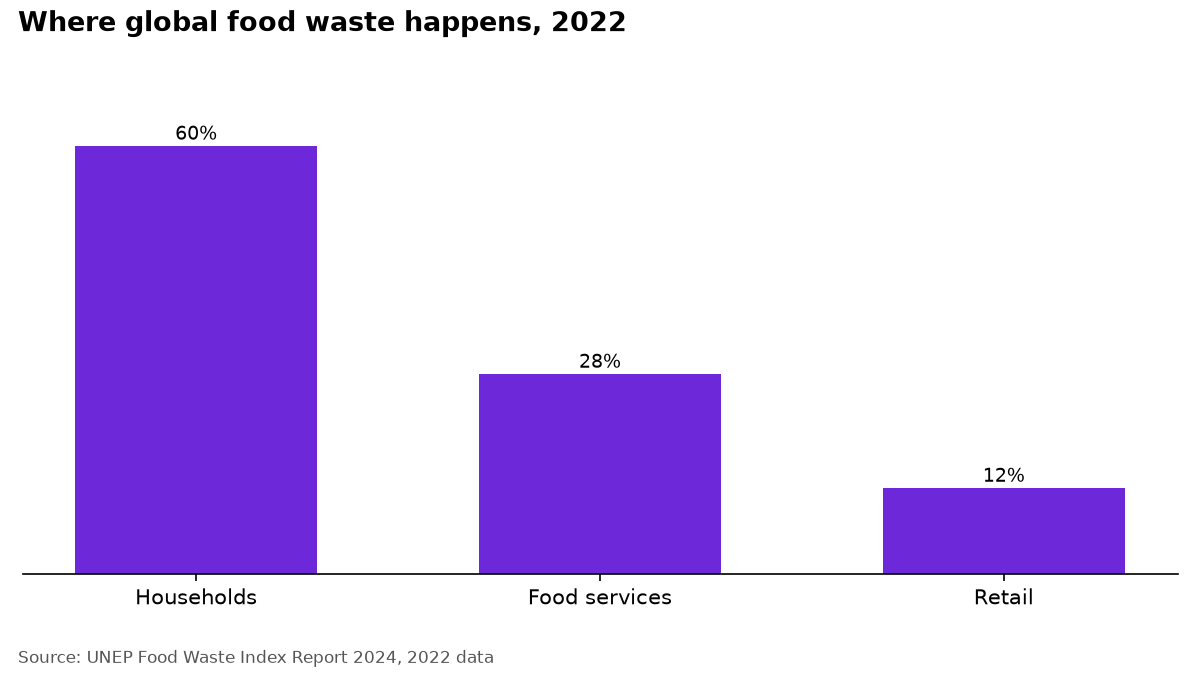
About a third of the food Americans buy goes uneaten, and worldwide most of that waste happens in homes.
- The US EPA says one-third of all food in the United States goes uneaten. (US EPA, Preventing Wasted Food At Home, 2026)
- The EPA estimates the average US family of four spends almost $3,000 per year on food that does not get eaten. (US EPA, Preventing Wasted Food At Home, 2026)
- In 2019, about 96 percent of US households' wasted food ended up in landfills, combustion facilities or the sewer, and only the remainder was composted, per EPA estimates. (US EPA, Preventing Wasted Food At Home, 2019)
- In 2024, 29% of the 240 million tons of food in the US supply went unsold or uneaten. (ReFED, Food Waste: The Problem, 2024)
- The value of surplus (unsold or uneaten) food in the US reached $381 billion in 2024, according to ReFED. (ReFED, Food Waste: The Problem, 2024)
- ReFED estimates consumer-level food waste in the US cost $259 billion in 2024. (ReFED, Consumer Food Waste Statistics & Solutions, 2024)
- Globally, 1.05 billion tonnes of food waste (including inedible parts) was generated in 2022, about 132 kilograms per person, per UNEP's Food Waste Index Report 2024. (UNEP, press release on the Food Waste Index Report 2024, 2022)
- Households were responsible for 60% of global food waste in 2022, versus 28% for food services and 12% for retail, according to UNEP. (UNEP, press release on the Food Waste Index Report 2024, 2022)
- UNEP says food loss and waste generates 8-10 per cent of annual global greenhouse gas emissions, almost five times the aviation sector. (UNEP, press release on the Food Waste Index Report 2024, 2024)
Foodborne illness and home food safety
Foodborne illness sends well over a hundred thousand Americans to hospital each year, which is why temperature and handling rules apply at home too.
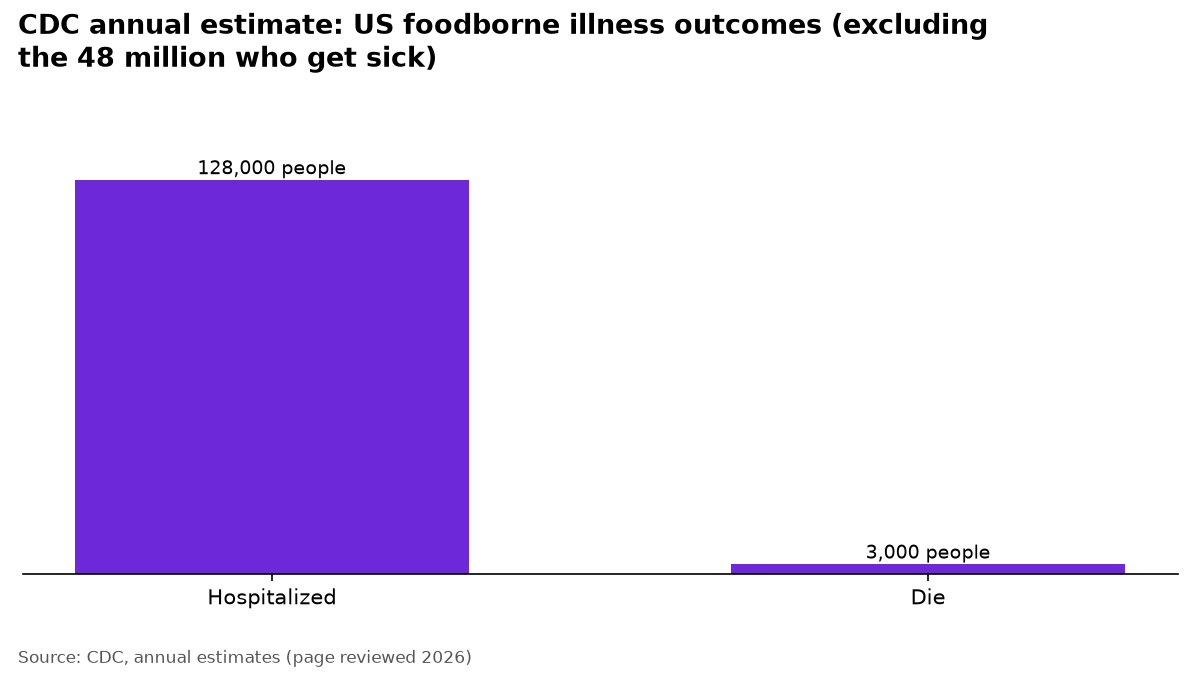
- CDC's headline estimate is that each year in the United States 48 million people get sick from a foodborne illness, 128,000 are hospitalized and 3,000 die. (CDC, About Food Safety (page reviewed March 9, 2026), 2026)
- Norovirus caused an estimated 5,540,000 domestically acquired foodborne illnesses in the United States in 2019, more than any other pathogen CDC tracked. (CDC, Estimates: Burden of Foodborne Illness in the United States, 2019)
- Salmonella was estimated to cause 238 deaths from domestically acquired foodborne illness in the United States in 2019. (CDC, Estimates: Burden of Foodborne Illness in the United States, 2019)
- The USDA Economic Research Service put the annual cost of 15 foodborne illnesses in the United States at $17.6 billion in 2018, up from $15.5 billion in 2013. (USDA Economic Research Service, Charts of Note: Foodborne Illness Costs, 2018)
- The food temperature danger zone, where bacteria grow fastest, runs from 40 to 140 degrees Fahrenheit, and food should not stay in it for more than two hours (NDSU Extension guide reviewed January 2026). (NDSU Extension, Keep Hot Foods Hot and Cold Foods Cold, 2026)
- NDSU Extension gives 160 F as the safe internal temperature for ground beef and ground pork, as measured with a food thermometer (guide reviewed January 2026). (NDSU Extension, Keep Hot Foods Hot and Cold Foods Cold, 2026)
- NDSU Extension gives 145 F as the safe internal temperature for beef, pork, lamb and veal roasts, steaks and chops (guide reviewed January 2026). (NDSU Extension, Keep Hot Foods Hot and Cold Foods Cold, 2026)
- Between 40 and 140 degrees F, bacteria populations can double in as little as 20 minutes, according to Clemson Extension (revised 2011). (Clemson Cooperative Extension HGIC, Effects of Temperature on Food, 2011)
- Clemson Extension recommends keeping a home refrigerator between 34 and 40 degrees F (revised 2011). (Clemson Cooperative Extension HGIC, Effects of Temperature on Food, 2011)
- FDA says cold or hot foods should not sit out longer than 2 hours, or 1 hour when the outdoor temperature is above 90 degrees F (page undated in the fetched text). (FDA, Handling Food Safely While Eating Outdoors, 2026)
Why drying preserves food
Microbes need free water: most spoilage bacteria stop below a water activity of about 0.90, and 0.85 is the regulatory cutoff drying aims below.
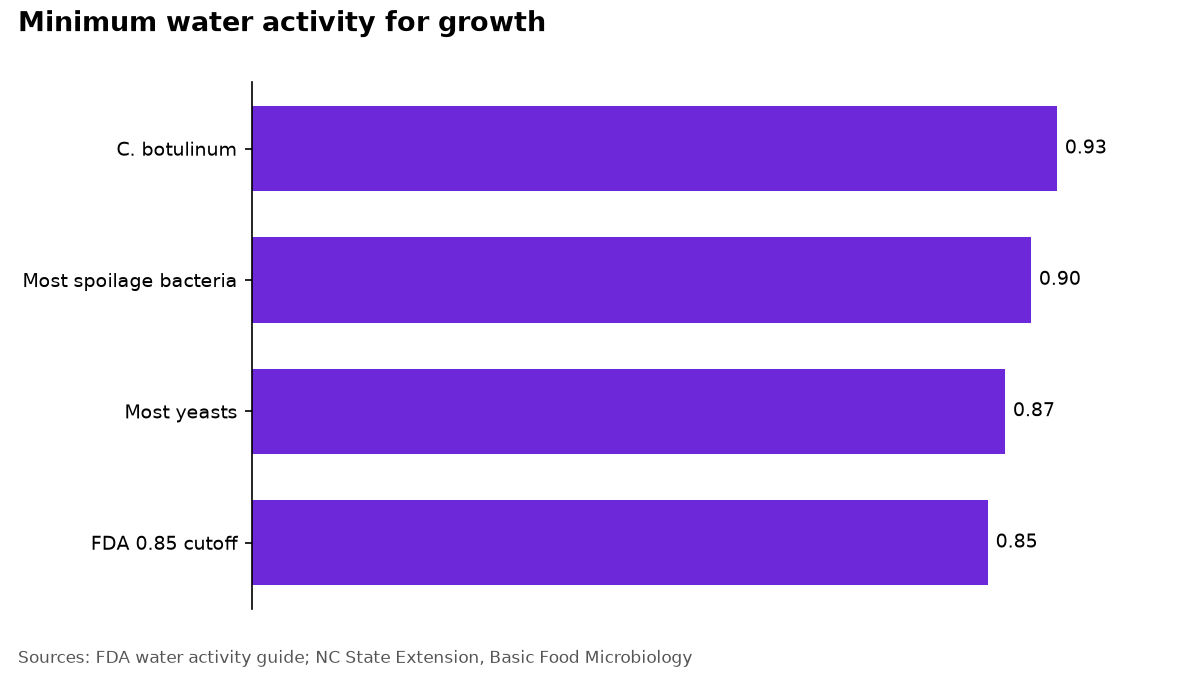
- The minimum water activity at which Clostridium botulinum can grow is approximately 0.93, and depending on product characteristics it can be as high as 0.96. (FDA, Water Activity (aw) in Foods (inspection technical guide), 2026)
- Foods whose finished-product water activity is controlled to 0.85 or less are not subject to the FDA low-acid canned food and acidified food regulations (21 CFR Parts 108, 113 and 114). (FDA, Water Activity (aw) in Foods (inspection technical guide), 2026)
- Most spoilage bacteria need a water activity of at least 0.90 to grow. (NC State Extension, Basic Food Microbiology, 2022)
- Most yeasts need a water activity of about 0.87 to grow. (NC State Extension, Basic Food Microbiology, 2022)
- Dried fruit is generally considered done when it reaches about 20 percent moisture content. (Ohio State University Extension, HYG-5347 (home drying of fruits and vegetables), 2015)
- Vegetables are dried until brittle or crisp, at which point only about 10 percent of their moisture remains. (University of Illinois Extension, Drying Food, 2026)
- Colorado State University Extension recommends drying fruit at 140 degrees F (60 C) in an oven or dehydrator. (Colorado State University Extension, Drying Fruits, 2025)
- To prevent browning, Penn State Extension's pretreatment is 3¾ teaspoons of powdered ascorbic acid in 2 cups of water, with fruit soaked for 10 minutes. (Penn State Extension, Drying Fruits and Vegetables, 2023)
- After drying, cooled fruit should be conditioned in a sealed container for 7 to 10 days to even out remaining moisture and reduce mold risk. (National Center for Home Food Preservation (UGA), Packaging and Storing Dried Foods, 2020)
Water content of common foods
Fresh fruit and vegetables are 75 to 95 percent water by weight, which is what a dehydrator has to remove.
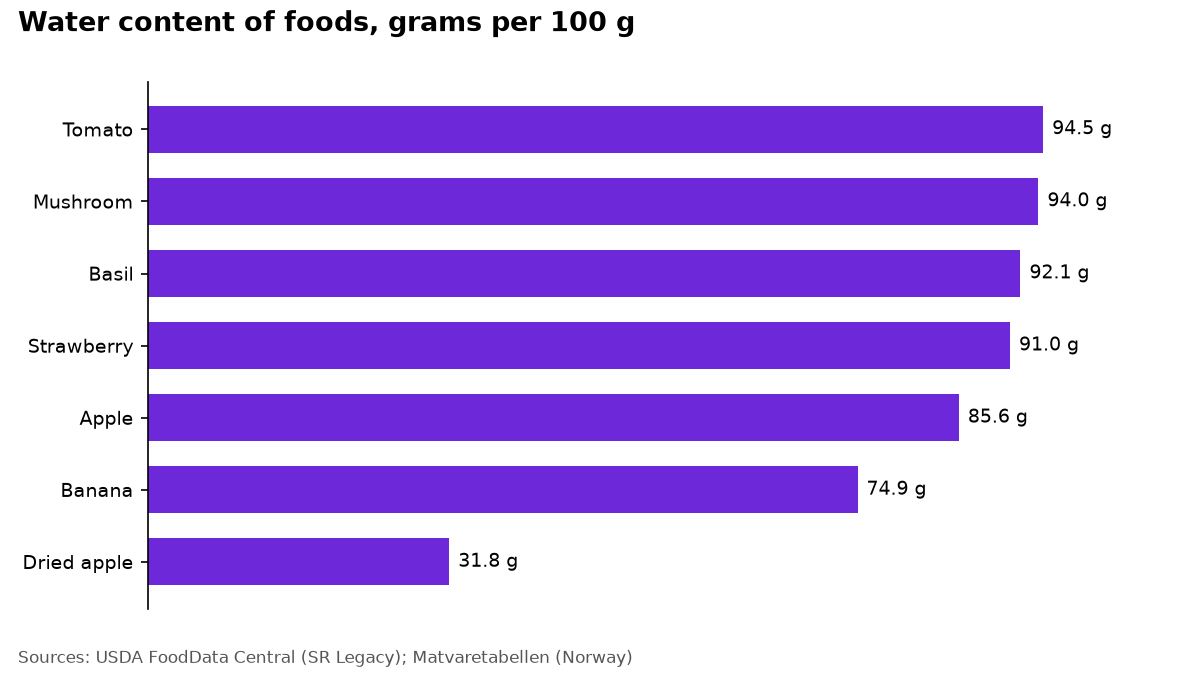
- Raw apples with skin contain 85.6 grams of water per 100 grams, according to USDA's SR Legacy data. (USDA FoodData Central, SR Legacy: Apples, raw, with skin (FDC ID 171688, published 4/1/2019), 2019)
- Dried, sulfured, uncooked apples still hold 31.8 grams of water per 100 grams in USDA's SR Legacy data, versus about 85.6 for raw apples. (USDA FoodData Central, SR Legacy: Apples, dried, sulfured, uncooked (FDC ID 171691, published 4/1/2019), 2019)
- Raw bananas contain 74.9 grams of water per 100 grams, noticeably less than most fruits, per USDA SR Legacy data. (USDA FoodData Central, SR Legacy: Bananas, raw (FDC ID 173944, published 4/1/2019), 2019)
- Fresh basil contains 92.1 grams of water per 100 grams in USDA's SR Legacy data. (USDA FoodData Central, SR Legacy: Basil, fresh (FDC ID 172232, published 4/1/2019), 2019)
- Raw red ripe tomatoes (year-round average) contain 94.5 grams of water per 100 grams, per USDA SR Legacy data. (USDA FoodData Central, SR Legacy: Tomatoes, red, ripe, raw, year round average (FDC ID 170457, published 4/1/2019), 2019)
- The Norwegian food composition table lists raw common mushrooms (champignons) at 94.0 grams of water per 100 grams of the food. (Matvaretabellen (Norwegian Food Composition Table, Norwegian Food Safety Authority/Directorate of Health): Mushroom, common, raw, 2025)
- The Norwegian food composition table lists raw strawberries at 91.0 grams of water per 100 grams of the food. (Matvaretabellen (Norwegian Food Composition Table): Strawberries, raw, 2025)
- Ohio State University Extension says properly dried vegetables contain only about 10 percent moisture, a level at which no known microorganisms can grow. (Ohio State University Extension, Drying Fruits and Vegetables (HYG-5347), 2015)
- Clemson Cooperative Extension advises that home-dried fruit should end up at about 20 percent moisture content. (Clemson Cooperative Extension (HGIC), Drying Fruits, 2026)
- Utah State University Extension's worked example for drying cherries targets 80% solids, which it states equals 20% water in the finished fruit. (Utah State University Extension, Preserve the Harvest: Testing Foods for Dryness, 2026)
- Colorado State University Extension states that the water content of properly dried food ranges from 5 to 25 percent depending on the food. (Colorado State University Extension, Drying Vegetables (reviewed Nov 2012), 2012)
Shelf life of dried foods
Dried food keeps for weeks to a year depending on the food and the storage temperature, so labeling and cool storage matter.
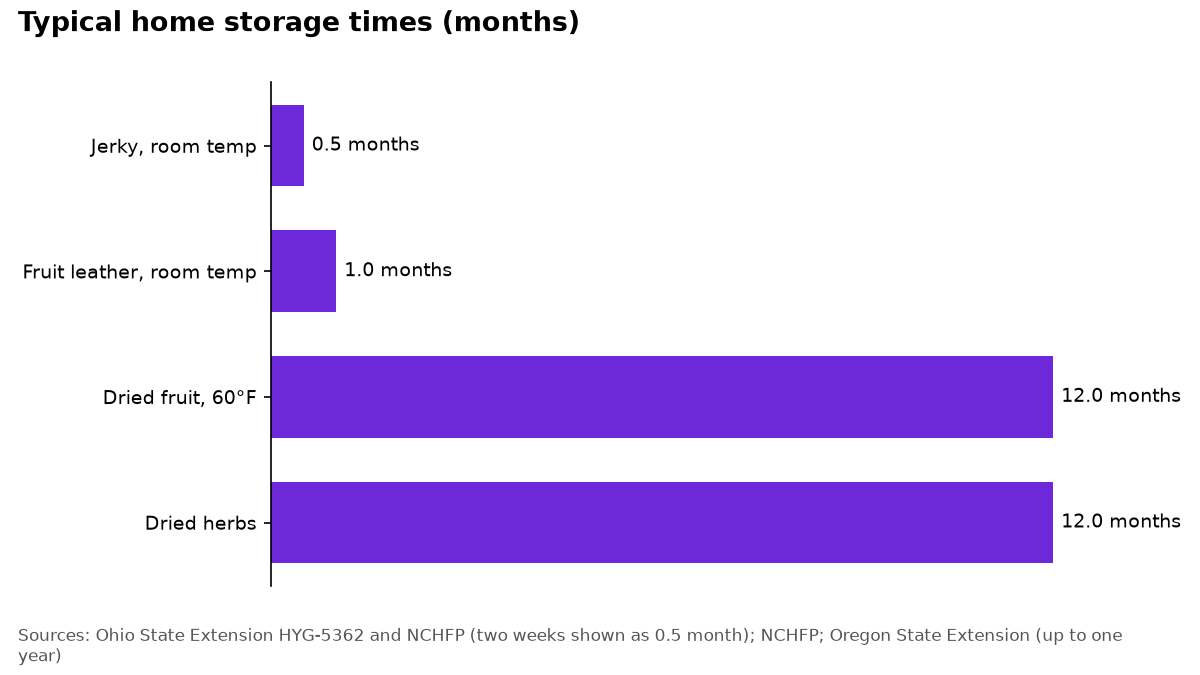
- Most dried fruits keep for 1 year when stored at 60 F, per NCHFP guidance. (National Center for Home Food Preservation (UGA), Packaging and Storing Dried Foods, 2020)
- Homemade fruit leather keeps up to 1 month at room temperature, and up to 1 year if tightly wrapped rolls are frozen. (National Center for Home Food Preservation (UGA), Fruit Leathers, 2020)
- Properly stored dried fruits keep well for six to 12 months, according to Colorado State University Extension. (Colorado State University Extension, Drying Fruits, 2025)
- Oregon State University Extension says the storage times of dehydrated produce range from 4 months to 1 year. (Oregon State University Extension, Safety tips for dehydrated produce?, 2021)
- Dried herbs can be stored effectively for up to one year in a cool, dry, dark place. (Oregon State University Extension, Drying Herbs, 2025)
- Properly dried and heat-treated jerky can be stored safely for up to two weeks at room temperature. (Ohio State University Extension, HYG-5362 (jerky), 2017)
- Properly dried and heat-treated jerky can be stored for three to six months in the refrigerator. (Ohio State University Extension, HYG-5362 (jerky), 2017)
- For every 10.8 degrees of temperature rise, the shelf life of stored food is cut in half, according to Utah State University Extension. (Utah State University Extension, 7 Factors That Prolong Your Food Storage Supply, 2026)
- Utah State University Extension names a constant 40-60 degree range as the best temperature for food storage. (Utah State University Extension, 7 Factors That Prolong Your Food Storage Supply, 2026)
- Foods stored long term, such as with oxygen absorbers in airtight containers, should have 10 percent or less moisture content, because moist food in reduced-oxygen packaging risks botulism. (Utah State University Extension, How Can I Get the Most Out of My Food Storage, 2026)
- Penn State Extension says dried fruit can be pasteurized before storage by chilling it in a freezer at 0 F or below for 48 hours. (Penn State Extension, Drying Fruits and Vegetables, 2023)
What a dehydrator costs to run
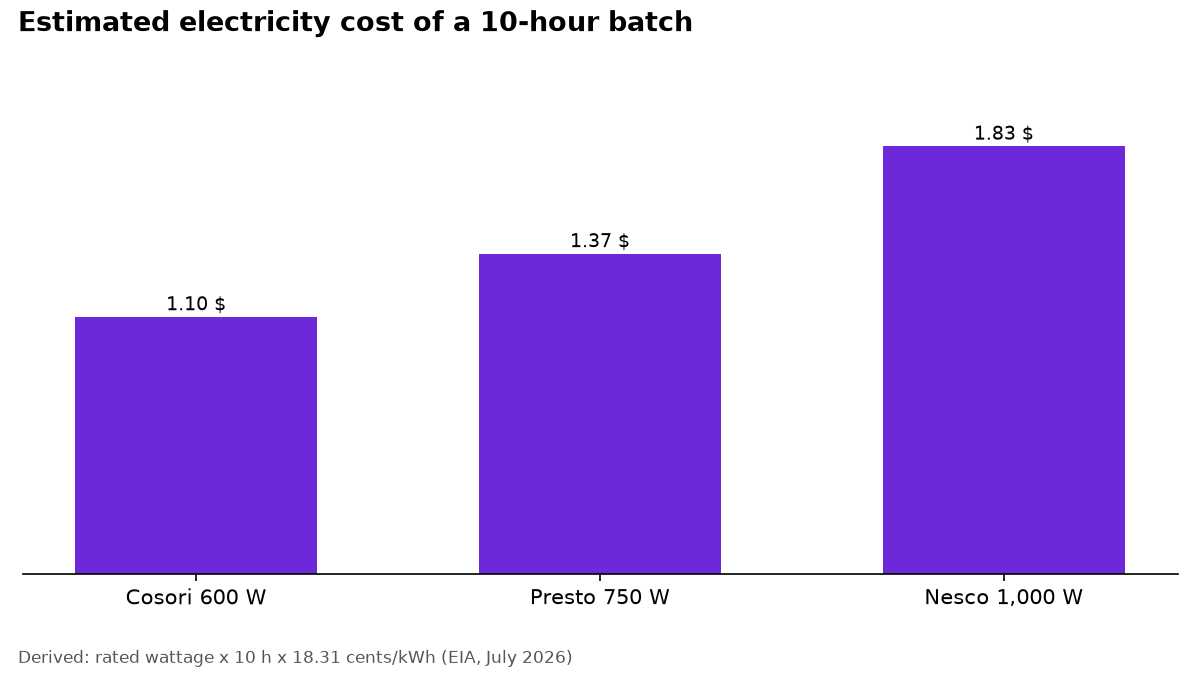
At the national average price, a 10-hour batch in a 600 to 1,000 watt dehydrator uses about $1.10 to $1.83 of electricity.
- In July 2026, the average US residential retail electricity price was 18.31 cents per kilowatt-hour. (U.S. Energy Information Administration, Electric Power Monthly Table 5.6.A, 2026)
- Across all of 2024, the average US residential electricity price for the total electric industry was 16.48 cents per kilowatt-hour. (U.S. Energy Information Administration, Electric Power Annual Table 2.4, 2024)
- In July 2026, Hawaii had the highest residential electricity price of any state, at 48.00 cents per kilowatt-hour. (U.S. Energy Information Administration, Electric Power Monthly Table 5.6.A, 2026)
- In 2022, the average US residential electric-utility customer bought 10,791 kilowatt-hours of electricity, about 899 kWh per month. (U.S. Energy Information Administration, FAQ: How much electricity does an American home use?, 2022)
- Presto lists its Dehydro Digital Electric Food Dehydrator model 06301 at 120 volts AC and 750 watts. (Presto (National Presto Industries), gopresto.com site search listing for Dehydro 06301, 2026)
- NESCO lists its FD-1040 Gardenmaster Digital Pro food dehydrator as offering 1000 watts of drying power. (NESCO, FD-1040 Gardenmaster Digital Pro Food Dehydrator product page, 2026)
- COSORI lists the rated power of its Premium 6-tray stainless steel food dehydrator, model CP267-FD, as 600 watts. (COSORI, Premium Stainless Steel Food Dehydrator CP267-FD product page, 2026)
- At the July 2026 US average residential price of 18.31 cents per kWh, running a Presto Dehydro Digital 06301 (750 W) for 10 hours costs about $1.37 (750 W x 10 h = 7.5 kWh x $0.1831); derived from the manufacturer's rated wattage and EIA's price, not measured. (our calculation) (Wattage from the manufacturer's page; price from US Energy Information Administration (derived), 2026)
- At the July 2026 US average residential price of 18.31 cents per kWh, running a Nesco FD-1040 Gardenmaster (1000 W) for 10 hours costs about $1.83 (1,000 W x 10 h = 10 kWh x $0.1831); derived from the manufacturer's rated wattage and EIA's price, not measured. (our calculation) (Wattage from the manufacturer's page; price from US Energy Information Administration (derived), 2026)
- At the July 2026 US average residential price of 18.31 cents per kWh, running a Cosori Premium CP267-FD (600 W) for 10 hours costs about $1.10 (600 W x 10 h = 6 kWh x $0.1831); derived from the manufacturer's rated wattage and EIA's price, not measured. (our calculation) (Wattage from the manufacturer's page; price from US Energy Information Administration (derived), 2026)
Home gardening and preserving
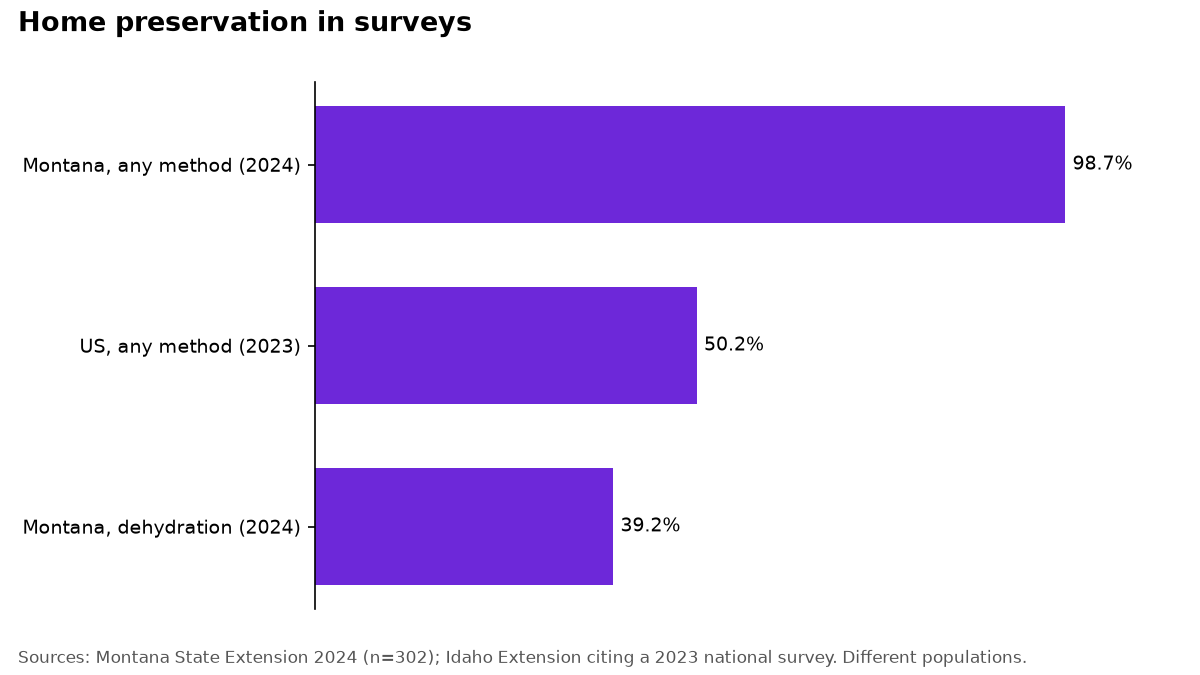
Home food preservation is common in surveys, but US gardening is shedding households even as spending hits a record.
- The National Gardening Survey 2026 edition reports that about 4.5 million US households left gardening in 2025. (National Gardening Association / GardenResearch.com, National Gardening Survey 2026 Edition, 2025)
- Total US spending on gardening reached an all-time high of $79.0 billion in 2025, up 13.5% from 2024, according to the National Gardening Survey 2026 edition. (National Gardening Association / GardenResearch.com, National Gardening Survey 2026 Edition, 2025)
- In a 2024 survey of 302 Montanans, 39.2% said they use dehydration to preserve food. (Montana State University Extension, 2024 Montana Food Preservation Survey Report, 2024)
- In the same 2024 survey of 302 Montanans, 98.7% of respondents reported using at least one form of home food preservation. (Montana State University Extension, 2024 Montana Food Preservation Survey Report, 2024)
- A 2023 national survey reported in a 2024 Journal of the Academy of Nutrition and Dietetics abstract found 50.2% of US respondents used at least one of 16 food preservation methods (including canning, dehydrating, fermenting and vacuum sealing). (University of Idaho Extension, Preserve@Home impact statement (citing J Acad Nutr Diet 2024 abstract), 2023)
- In the National Gardening Association's 2022 survey, 41% of US households (roughly 53.7 million) took part in food gardening in 2021. (FOX Television Stations report on the National Gardening Association 2022 survey, 2021)
Jerky and meat-snack safety
Home jerky guidance centers on three temperatures: heat the meat to 160°F, dry at 145°F or hotter, and use 275°F for a post-heat step.
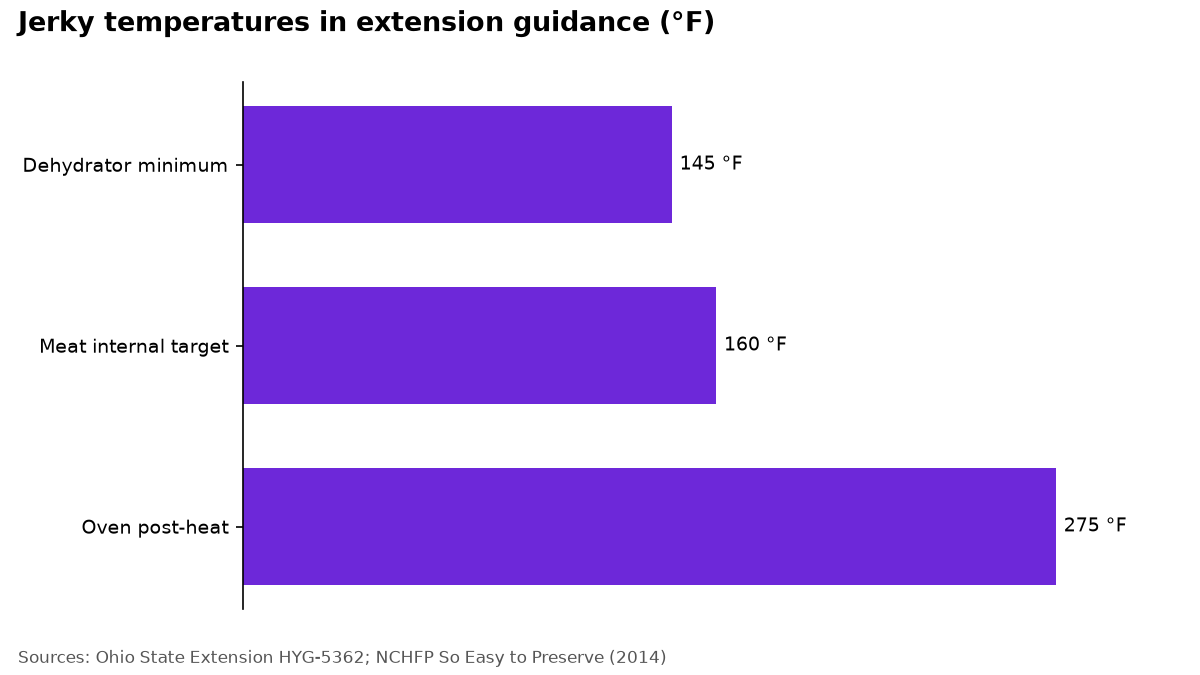
- NCHFP says home jerky meat should reach an internal temperature of 160 degrees F, for example by boiling strips in marinade for 5 minutes, before drying (So Easy to Preserve, 6th ed., 2014). (National Center for Home Food Preservation, Making Jerky, 2014)
- If jerky strips were not heated before drying, NCHFP says to heat them 10 minutes in an oven preheated to 275 degrees F after drying (strips no thicker than 1/4 inch; 2014 edition). (National Center for Home Food Preservation, Making Jerky, 2014)
- NCHFP says properly dried homemade jerky keeps for two weeks at room temperature in a sealed container (2014 edition). (National Center for Home Food Preservation, Making Jerky, 2014)
- Ohio State University Extension says a dehydrator used for jerky must hold at least 145 degrees F (fact sheet HYG-5362, posted 2017). (Ohio State University Extension, Food Preservation: Making Jerky (HYG-5362), 2017)
- Ohio State University Extension says jerky meat should be cut no more than 1/4 inch thick (fact sheet HYG-5362, posted 2017). (Ohio State University Extension, Food Preservation: Making Jerky (HYG-5362), 2017)
- A 1995 New Mexico salmonellosis outbreak linked to beef jerky (carne seca) from one plant had 93 persons meeting the probable or confirmed case definition. (CDC MMWR, Outbreak of Salmonellosis Associated with Beef Jerky, New Mexico, 1995, 1995)
- In the 1995 New Mexico beef jerky outbreak, the plant dried partially frozen slices at 140 F for 3 hours, then held them at 115 F for about 19 hours, which was too cool to stop Salmonella. (CDC MMWR, Outbreak of Salmonellosis Associated with Beef Jerky, New Mexico, 1995, 1995)
- As of January 2026, CDC says chronic wasting disease has been reported in wild deer in 36 U.S. states and advises not eating meat from an animal that tests positive. (CDC, About Chronic Wasting Disease (page dated Jan. 21, 2026), 2026)
- The Minnesota Department of Health reports it has not identified any potential cases or clusters of human prion disease related to chronic wasting disease, and does not recommend eating meat from a prion-infected animal. (Minnesota Department of Health, Chronic Wasting Disease, 2026)
Dried fruit and vegetables: production and use
US raisin shipments fell 7 percent in 2024/25, and grapes and dates make up roughly three-quarters of world dried-fruit consumption.
- World dried fruit production was 3.24 million metric tons in the 2024/25 season, with an estimated 3.14 million metric tons forecast for 2025/26. (International Nut & Dried Fruit Council (INC), Nuts and Dried Fruit Global Statistical Review 2025 Edition, 2024)
- In 2024, dried grapes (raisins) accounted for 39% and dates for 37% of world dried fruit consumption. (International Nut & Dried Fruit Council (INC), Nuts and Dried Fruit Global Statistical Review 2025 Edition, 2024)
- The California Prune Board estimated an average 2024 California prune crop of 65,000 metric tons (71,650 short tons), as reported by the INC. (California Prune Board press release, California Prune Production Navigating the Heat Wave (July 23, 2024), 2024)
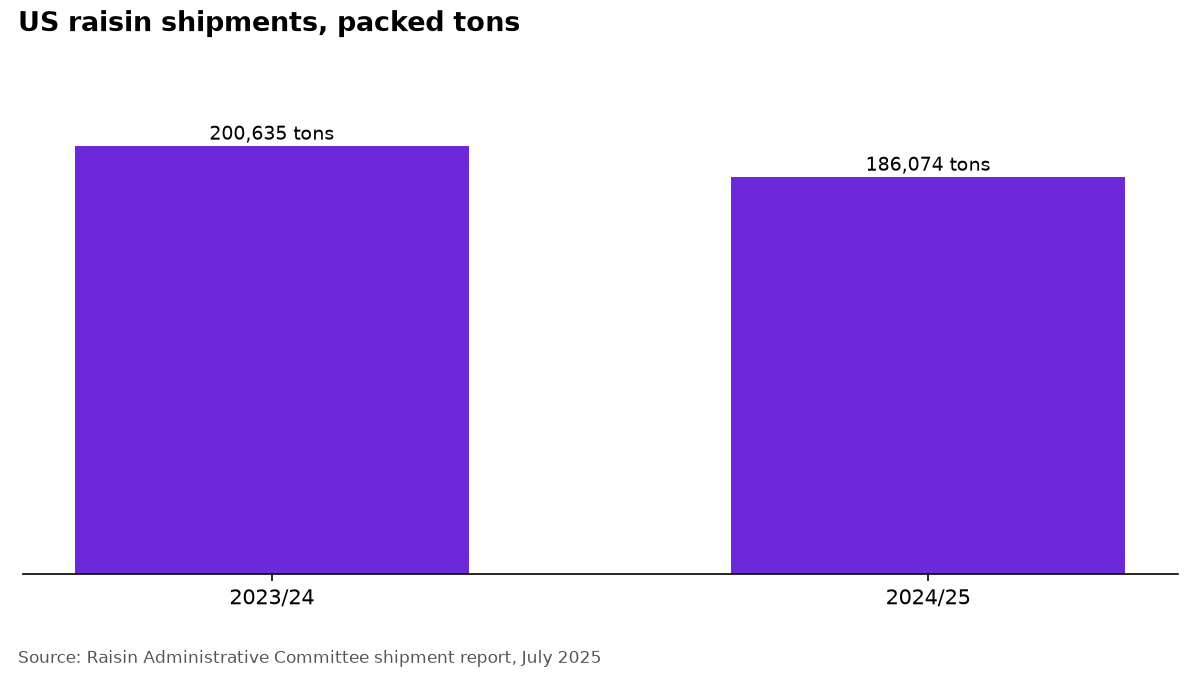
- Total commercial raisin shipments in the 2024/25 crop year (August 2024 to July 2025) were 186,074 packed tons, 7% below the 200,635 packed tons shipped the year before. (Raisin Administrative Committee, Comparative Commercial Raisin Shipment Data (July 2025 final), 2025)
- Export-free raisin shipments of all varieties totaled 48,908 packed tons in the 2024/25 crop year (August 2024 to July 2025). (Raisin Administrative Committee, Comparative Commercial Raisin Shipment Data (July 2025 final), 2025)
- In 2024/25 (August to July), US per capita availability of processed grapes (canned, dried and juice, excluding wine) was 7.14 pounds on a fresh-weight basis, down 13 percent year over year. (USDA Economic Research Service, Fruit and Tree Nuts Outlook: September 2025 (FTS-383), 2025)
- Natural Seedless varieties made up 86 percent of California raisin shipment volume in 2024/25, ahead of Golden Seedless at 6 percent. (USDA Economic Research Service, Fruit and Tree Nuts Outlook: September 2025 (FTS-383), 2025)
- In 2021, US per capita daily fruit intake averaged 0.817 cup equivalents, of which dried fruit supplied just 0.013 cup equivalents (2 percent). (USDA Economic Research Service, Economic Research Report 341 (December 2024), 2021)
Outdoor recreation and backpacking food
Record outdoor participation means tens of millions of potential campers and hikers who need lightweight, shelf-stable food.
- The US outdoor recreation economy accounted for $696.7 billion of current-dollar GDP in 2024, or 2.4 percent of the national total. (US Bureau of Economic Analysis, Outdoor Recreation Economic Statistics for the US and States, 2024, 2024)
- Inflation-adjusted GDP of the US outdoor recreation economy grew 2.7 percent in 2024. (US Bureau of Economic Analysis, Outdoor Recreation Economic Statistics for the US and States, 2024, 2024)
- The National Park Service recorded 323 million recreation visits to national park system units in calendar year 2025. (National Park Service, Visitor Use Statistics, 2025)
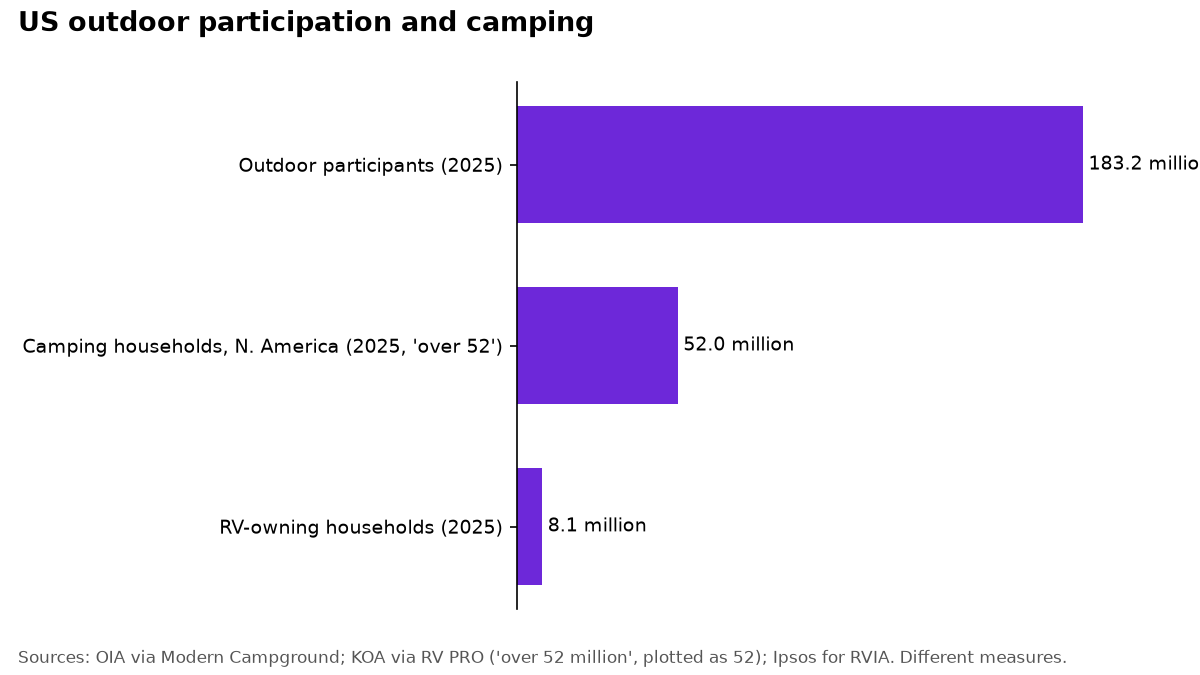
- US outdoor recreation participation reached a record 183.2 million people in 2025, or 59% of Americans aged six and older. (Modern Campground (Outdoor Hospitality News), reporting the OIA/Outdoor Foundation 2025 Outdoor Participation Trends Report, 2025)
- Outdoor participation among seniors rose 7.4% in the Outdoor Industry Association's 2025 Outdoor Participation Trends Report. (Outdoor Industry Association, 2025 Outdoor Participation Trends Report (executive summary), 2025)
- The number of 'core' (most frequent) US outdoor participants increased by 5 million in the 2025 Outdoor Participation Trends Report. (Outdoor Industry Association, 2025 Outdoor Participation Trends Report (executive summary), 2025)
- More than 52 million North American households went camping in 2025, according to KOA's annual Camping & Outdoor Hospitality Report. (RV PRO, reporting the KOA Camping & Outdoor Hospitality Report, 2025)
- In a 2025 Ipsos study for the RV Industry Association, 8.1 million US households owned an RV, about 6.7% of US households. (RV Industry Association, 2025 Go RVing RV Owner Demographic Profile, 2025)
How we checked these figures
Selection: 91 statistics from 35 publishers, most of them government agencies, universities and extension services, plus trade bodies. Each figure was found by opening the page it cites and copying the number as printed; a script then re-fetched every URL and confirmed the number appears on the page. A person then read each claim against the surrounding text (same population, unit, country and year) and reworded those that overreached. Where a page could not be read by script (PDFs, JavaScript-rendered USDA FoodData Central pages and one manufacturer page that blocks scripts), the number was read by hand and marked as a manual check. Exceptions to know about: four statistics rest on secondary sources because the primary page was unreachable (an Idaho Extension document quoting a 2023 national survey, a Fox 6 report of a National Gardening Association survey, Modern Campground on the Outdoor Industry Association report, and RV PRO on the KOA report). Three running-cost statistics are our own calculations, labelled derived: manufacturer-rated wattage x 10 hours x the July 2026 EIA average residential price. They are estimates, not measurements. USDA FoodData Central water values are shown to the one decimal the public page prints. Extension drying targets (10% or 20% moisture) are guidance for finished dried food, not measured food composition. Years: the year is the year the figure describes. Where a guidance page prints no date, the year is 2026, the year it was read. Older figures (for example a 1995 outbreak report) are included only where the history is the point. Thresholds: this is a narrow topic with little primary data on dehydrators themselves, so the page uses a lower bar than a typical statistics hub, agreed before it was built: at least 80 statistics, 8 sections and 20 distinct publishers. Recency: 59% of the statistics are dated 2024 or later; the usual 70% bar was lowered to 55% because much of the page is stable reference material (food composition tables, food-safety and drying guidance) that is not republished every year. Each statistic shows its own year so readers can judge. Because several sections rest on government sources, the share from any single publisher is kept under 12%. Statistics are refreshed quarterly; the next review is due 6 January 2027. No first-party data is used.
Sources
- bea.gov: US Bureau of Economic Analysis, Outdoor Recreation Economic Statistics for the US and States, 2024
- californiaprunes.org: California Prune Board press release, California Prune Production Navigating the Heat Wave (July 23, 2024)
- cdc.gov: CDC, About Food Safety (page reviewed March 9, 2026); CDC, Estimates: Burden of Foodborne Illness in the United States; CDC MMWR, Outbreak of Salmonellosis Associated with Beef Jerky, New Mexico, 1995; CDC, About Chronic Wasting Disease (page dated Jan. 21, 2026)
- content-hub.uidaho.edu: University of Idaho Extension, Preserve@Home impact statement (citing J Acad Nutr Diet 2024 abstract)
- content.ces.ncsu.edu: NC State Extension, Basic Food Microbiology
- cosori.com: COSORI, Premium Stainless Steel Food Dehydrator CP267-FD product page; Wattage from the manufacturer's page
- eia.gov: U.S. Energy Information Administration, Electric Power Monthly Table 5.6.A; U.S. Energy Information Administration, Electric Power Annual Table 2.4; U.S. Energy Information Administration, FAQ: How much electricity does an American home use?
- epa.gov: US EPA, Preventing Wasted Food At Home
- ers.usda.gov: USDA Economic Research Service, Charts of Note: Foodborne Illness Costs; USDA Economic Research Service, Fruit and Tree Nuts Outlook: September 2025 (FTS-383); USDA Economic Research Service, Economic Research Report 341 (December 2024)
- extension.colostate.edu: Colorado State University Extension, Drying Fruits; Colorado State University Extension, Drying Vegetables (reviewed Nov 2012)
- extension.illinois.edu: University of Illinois Extension, Drying Food
- extension.oregonstate.edu: Oregon State University Extension, Safety tips for dehydrated produce?; Oregon State University Extension, Drying Herbs
- extension.psu.edu: Penn State Extension, Drying Fruits and Vegetables
- extension.usu.edu: Utah State University Extension, Preserve the Harvest: Testing Foods for Dryness; Utah State University Extension, 7 Factors That Prolong Your Food Storage Supply; Utah State University Extension, How Can I Get the Most Out of My Food Storage
- fda.gov: FDA, Handling Food Safely While Eating Outdoors; FDA, Water Activity (aw) in Foods (inspection technical guide)
- fdc.nal.usda.gov: USDA FoodData Central, SR Legacy: Apples, raw, with skin (FDC ID 171688, published 4/1/2019); USDA FoodData Central, SR Legacy: Apples, dried, sulfured, uncooked (FDC ID 171691, published 4/1/2019); USDA FoodData Central, SR Legacy: Bananas, raw (FDC ID 173944, published 4/1/2019); USDA FoodData Central, SR Legacy: Basil, fresh (FDC ID 172232, published 4/1/2019); USDA FoodData Central, SR Legacy: Tomatoes, red, ripe, raw, year round average (FDC ID 170457, published 4/1/2019)
- fox6now.com: FOX Television Stations report on the National Gardening Association 2022 survey
- gardenresearch.com: National Gardening Association / GardenResearch.com, National Gardening Survey 2026 Edition
- gopresto.com: Presto (National Presto Industries), gopresto.com site search listing for Dehydro 06301; Wattage from the manufacturer's page
- health.state.mn.us: Minnesota Department of Health, Chronic Wasting Disease
- hgic.clemson.edu: Clemson Cooperative Extension HGIC, Effects of Temperature on Food; Clemson Cooperative Extension (HGIC), Drying Fruits
- inc.nutfruit.org: International Nut & Dried Fruit Council (INC), Nuts and Dried Fruit Global Statistical Review 2025 Edition
- matvaretabellen.no: Matvaretabellen (Norwegian Food Composition Table, Norwegian Food Safety Authority/Directorate of Health): Mushroom, common, raw; Matvaretabellen (Norwegian Food Composition Table): Strawberries, raw
- moderncampground.com: Modern Campground (Outdoor Hospitality News), reporting the OIA/Outdoor Foundation 2025 Outdoor Participation Trends Report
- montana.edu: Montana State University Extension, 2024 Montana Food Preservation Survey Report
- nchfp.uga.edu: National Center for Home Food Preservation (UGA), Packaging and Storing Dried Foods; National Center for Home Food Preservation (UGA), Fruit Leathers; National Center for Home Food Preservation, Making Jerky
- ndsu.edu: NDSU Extension, Keep Hot Foods Hot and Cold Foods Cold
- nesco.com: NESCO, FD-1040 Gardenmaster Digital Pro Food Dehydrator product page; Wattage from the manufacturer's page
- nps.gov: National Park Service, Visitor Use Statistics
- ohioline.osu.edu: Ohio State University Extension, HYG-5347 (home drying of fruits and vegetables); Ohio State University Extension, Drying Fruits and Vegetables (HYG-5347); Ohio State University Extension, HYG-5362 (jerky); Ohio State University Extension, Food Preservation: Making Jerky (HYG-5362)
- oia.outdoorindustry.org: Outdoor Industry Association, 2025 Outdoor Participation Trends Report (executive summary)
- raisins.org: Raisin Administrative Committee, Comparative Commercial Raisin Shipment Data (July 2025 final)
- refed.org: ReFED, Food Waste: The Problem; ReFED, Consumer Food Waste Statistics & Solutions
- rv-pro.com: RV PRO, reporting the KOA Camping & Outdoor Hospitality Report
- rvia.org: RV Industry Association, 2025 Go RVing RV Owner Demographic Profile
- unep.org: UNEP, press release on the Food Waste Index Report 2024
