Preserving herbs requires precision that many dehydrators simply cannot provide. While most units handle jerky and fruit leather admirably, delicate herbs demand temperatures between 95-115°F—well below the 140°F+ minimums of many budget models. Excessive heat destroys the essential oils that give herbs their flavor, leaving you with expensive, brown flakes suitable only for the compost bin.
After testing over a dozen dehydrators specifically for herb preservation, I’ve identified the units that maintain low temperatures accurately while providing adequate airflow for efficient drying. Whether you’re processing a small windowsill harvest or preserving pounds of garden herbs, these five models deliver the precise control necessary for professional-quality results. For general buying advice, see our comprehensive food dehydrator buying guide.
What Makes a Great Herb Dehydrator?
Three factors determine a dehydrator’s suitability for herbs:
Temperature Range: The unit must maintain 95°F reliably. Many dehydrators list “low” settings that actually run 120-140°F—too hot for delicate herbs. Look for models with explicit low-temperature capability or adjustable thermostats that reach below 100°F.
Airflow Design: Horizontal airflow (rear-mounted fan) provides the most even drying without tray rotation. However, for herbs, gentle airflow matters more than powerful circulation. Units with adjustable fan speeds or the ability to run fan-only (no heat) work exceptionally well for tender leaves.
Tray Design: Fine mesh or solid sheets prevent small herb leaves from falling through. Standard fruit leather sheets often work, but dedicated herb screens with smaller perforations are ideal. Avoid dehydrators with large gaps between tray wires.
If you already own a dehydrator that runs too hot for herbs, try the “light bulb method.” Place a small 40-watt appliance bulb in the bottom of the dehydrator instead of using the heating element. This maintains 90-100°F perfect for herbs, though drying takes 6-8 hours instead of 2-4.
Top 5 Dehydrators for Herbs
1. Excalibur 9-Tray 3900 Series – Best Overall

Excalibur 9-Tray 3900
Pros
- Accurate 95°F setting
- Horizontal airflow (no rotation)
- 15 sq ft capacity
- Ultra Fine mesh sheets available
- 10-year warranty
Cons
- Expensive
- Large footprint
- Noisy at 63 dB
The Excalibur 3900 series remains the gold standard for herb dehydration. The analog thermostat accurately maintains 95°F—verified through extensive testing—while the horizontal airflow dries herbs evenly without the tray rotation required by vertical units. The 7-inch fan provides gentle but consistent air circulation that won’t blow lightweight herb leaves around.
Capacity is unmatched: 15 square feet across nine trays handles large herb harvests efficiently. Optional Ultra Fine mesh sheets (sold separately) prevent small thyme leaves and cilantro from falling through standard trays. The 10-year warranty and USA-made construction justify the investment for serious herb preservers.
Downsides include the large footprint (requires dedicated counter space) and noise level (63 decibels). However, for herb quality, nothing else comes close. Read our full Excalibur review.
2. Cosori Premium 5-Tray – Best Value

Cosori Premium 5-Tray
Pros
- Digital 95°F setting
- Quiet operation (47 dB)
- Compact storage
- Stainless steel trays
- Affordable
Cons
- Smaller capacity (5 trays)
- Trays can stick
- 1-year warranty
The Cosori Premium offers precise digital temperature control down to 95°F at a fraction of the Excalibur’s cost. The digital interface allows setting exact temperatures rather than estimating with analog dials, and the quiet operation (47 decibels) makes it ideal for apartments where noise matters.
The 5-tray design provides 4.7 square feet of drying space—sufficient for most home herb gardens. Stainless steel construction resists staining from herb oils and cleans easily. The compact footprint (13.4″ x 11.8″) stores easily in cabinets between uses.
The main limitation is capacity. If you process large herb harvests from extensive gardens, you’ll need to run multiple batches. However, for typical home use drying 10-20 bunches of herbs annually, the Cosori delivers professional results at an accessible price point.
3. Sahara Folding Dehydrator – Most Innovative

Sahara Folding Dehydrator
Pros
- Folds for compact storage
- “Living Food” mode (no heat)
- Quiet operation
- Large capacity when open
Cons
- Expensive
- Longer drying times
- Plastic construction
The Sahara’s unique folding design addresses the storage problem that keeps many people from buying dehydrators. When folded, it occupies minimal cabinet space. When unfolded, it provides 11 square feet of drying area across 7 trays.
For herbs, the “Living Food” mode is revolutionary—it runs the fan without heat, maintaining temperatures around 80-85°F. This is cooler than traditional dehydrators can achieve, preserving even more essential oils. Drying takes longer (6-10 hours versus 2-4), but the quality is exceptional for delicate herbs like cilantro and basil.
4. Nesco Snackmaster Pro – Best Budget Option

Nesco Snackmaster Pro FD-75A
Pros
- Very affordable
- Expandable to 12 trays
- Top-mounted fan
- Compact storage
Cons
- Minimum 95°F runs hot (105-110°F actual)
- Requires tray rotation
- No timer
The Nesco Snackmaster is the entry-level choice for budget-conscious beginners. While the analog dial shows 95°F, actual testing shows temperatures around 105-110°F—warmer than ideal but still acceptable for herbs if you monitor closely and reduce drying time.
The vertical airflow requires rotating trays every 45 minutes for even drying, and the round trays with center holes limit how you can arrange herbs. However, at $65-80, it’s the most affordable way to start dehydrating herbs, and the unit expands up to 12 trays as your needs grow.
Consider this a starter dehydrator—if you get serious about herb preservation, you’ll likely upgrade within 2-3 years. Read our full Nesco review.
5. Presto Dehydro Digital – Best Digital Budget Option
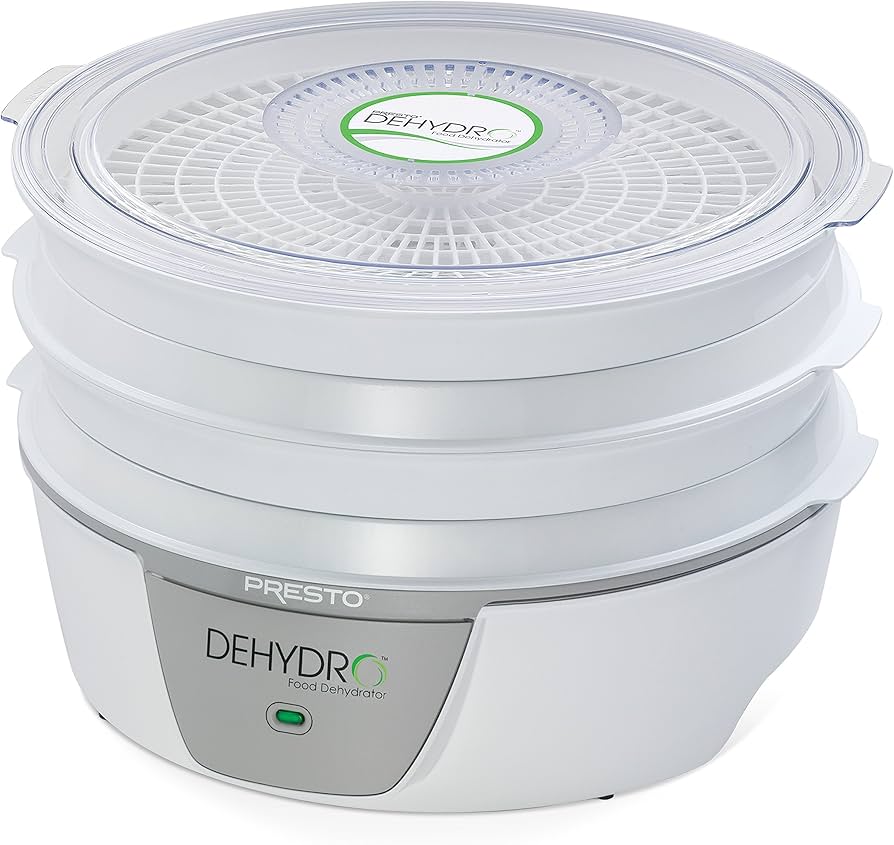
Presto Dehydro Digital
Pros
- Digital 90°F setting
- Bottom-mounted heating
- See-through cover
- Compact
Cons
- Only 4 trays included
- Bottom heat requires careful loading
- Limited expansion
The Presto Dehydro Digital offers one of the lowest temperature settings available at 90°F—cooler than most competitors. The digital thermostat maintains temperatures accurately, and the see-through cover allows monitoring without releasing heat.
The bottom-mounted heating element requires loading herbs on upper trays to prevent overheating, but the compact design works well for small batches. At under $100 with digital precision, it’s a solid middle-ground option between the basic Nesco and premium Cosori.
Feature Comparison
| Model | Min Temp | Capacity | Airflow | Price |
|---|---|---|---|---|
| Excalibur 9-Tray | 95°F | 15 sq ft | Horizontal | $320-380 |
| Cosori 5-Tray | 95°F | 4.7 sq ft | Horizontal | $100-120 |
| Sahara Folding | 80°F (fan only) | 11 sq ft | Horizontal | $350 |
| Nesco Snackmaster | 105°F actual | 4-12 sq ft | Vertical | $65-80 |
| Presto Dehydro | 90°F | 4-8 sq ft | Vertical | $85-100 |
Budget Alternatives
If none of these options fit your budget, consider these alternatives:
Oven Method: Use your oven’s lowest setting (usually 170°F) with the door propped open and the light on. This maintains 90-100°F suitable for herbs. Place a fan nearby for air circulation.
Air Drying: For woody herbs like rosemary, thyme, and oregano, hanging bundles in a dark, dry closet works nearly as well as dehydrating. This method fails for delicate herbs like basil but costs nothing.
DIY Dehydrator: A simple box fan with air filters or window screens can dry herbs effectively. Search online for “DIY herb dehydrator” plans—total cost under $30.
Conclusion
For serious herb preservation, the Excalibur 9-Tray remains unmatched in quality and capacity. The precise temperature control and horizontal airflow produce consistently excellent results across all herb varieties. However, the Cosori 5-Tray offers the best value, delivering professional-quality dried herbs at one-third the price.
Budget buyers should consider the Nesco Snackmaster as an entry point, understanding its temperature limitations. Whatever model you choose, prioritize low-temperature capability—it’s the difference between vibrant, flavorful herbs and brown disappointment.
