Beef jerky represents the ultimate test for a food dehydrator. Unlike fruits or herbs where minor temperature variations affect only quality, jerky requires precise temperature control to ensure food safety. Under-dried jerky can harbor E. coli, Salmonella, and Listeria—pathogens that cause serious illness. Yet many popular dehydrators fail to reach the 160°F internal temperature necessary to destroy these bacteria, creating dangerous conditions for home jerky makers.
Over six months, I tested 12 dehydrators specifically for jerky production, measuring internal meat temperatures, drying consistency, capacity, and ease of cleaning. Each unit processed over 20 pounds of marinated beef through multiple batches. The results reveal significant differences in safety compliance, with some units requiring workarounds while others deliver professional results out of the box. Whether you’re a hunter processing game meat or simply want healthy protein snacks, these are the dehydrators that safely deliver excellent jerky.
Jerky Safety Requirements
Before reviewing specific models, understand what makes a dehydrator safe for jerky production. The USDA specifies that jerky must reach 160°F internal temperature to destroy pathogens. However, most home dehydrators heat slowly, and the surface of meat strips can dry before the interior reaches safe temperatures—creating “case hardening” that traps bacteria inside.
A safe jerky dehydrator must either:
- Reach and maintain 160-165°F air temperature reliably
- Allow pre-heating meat in an oven to 160°F before dehydrating
- Have sufficient airflow to dry meat before surface hardening occurs
Critical Test: Place a probe thermometer in the thickest piece of meat after 30 minutes of drying. It should read at least 155°F and climbing toward 160°F. If it’s below 150°F, your dehydrator cannot safely process jerky without pre-heating.
Never consume jerky that hasn’t reached 160°F internal temperature during processing. If your dehydrator cannot achieve this, use the oven pre-heating method: bake strips at 300°F until they reach 160°F internal temp, then transfer to the dehydrator to finish drying. This step is non-negotiable for food safety.
Top 5 Jerky Dehydrators
1. Excalibur 9-Tray 3900 – Best Overall for Jerky

Excalibur 9-Tray 3900
Pros
- Reaches 165°F reliably
- 15 sq ft capacity (6 lbs meat)
- Horizontal airflow (even drying)
- 10-year warranty
- Made in USA
Cons
- Expensive
- Noisy (63 dB)
- Temperature runs 10°F cool (verify with thermometer)
The Excalibur remains the gold standard for jerky production. In testing, it consistently reached 160°F internal meat temperature in 3 hours when set to 165°F. The horizontal airflow dries evenly across all nine trays without rotation, and the 15-square-foot capacity handles 6 pounds of meat simultaneously—enough for a serious hunter’s batch or a month’s worth of snacks.
The 600-watt element and large 7-inch fan move serious air, preventing case hardening. Square trays accommodate full-length jerky strips without curling them around a central column. The 10-year warranty and USA-made construction justify the investment for serious jerky enthusiasts. Read full review.
The Excalibur’s analog dial typically runs 10°F cooler than indicated. For jerky safety, set the dial to 170°F to ensure you reach 160°F actual temperature. Always verify with a probe thermometer the first few uses to calibrate your specific unit.
2. Cosori Premium 6-Tray – Best Value for Jerky

Cosori Premium 6-Tray
Pros
- Digital 165°F setting
- Accurate temperature (±2°F)
- Stainless steel trays
- Quiet operation (48 dB)
- Auto shutoff
Cons
- Smaller capacity (4 lbs)
- 2-year warranty
- Trays can stick to meat
The Cosori Premium delivers 90% of the Excalibur’s jerky-making performance at half the price. The digital thermostat accurately maintains 165°F—verified within 2°F in testing—and the 165°F maximum provides the safety margin needed for beef jerky.
The rear-mounted fan provides even drying without tray rotation, and the stainless steel construction resists corrosion from acidic marinades. At 48 decibels, it runs quietly enough for overnight operation. The 6.5-square-foot capacity handles 4 pounds of meat per batch—adequate for most households.
For home jerky makers who don’t need the Excalibur’s massive capacity, the Cosori offers the best value proposition. The digital precision eliminates guesswork, and the quiet operation allows “set and forget” convenience. Read full review.
3. LEM MightyBite 10-Tray – Best for Hunters

LEM MightyBite 10-Tray
Pros
- 167°F maximum setting
- Designed for game meat
- 800-watt element
- Drip tray included
- 12 sq ft drying space
Cons
- Acrylic (not glass) door
- Plastic construction
- Requires tray rotation
Built specifically for hunters and meat processors, the MightyBite goes up to 167°F, comfortably above the 160°F USDA guideline for jerky. This extra heat ensures game meat reaches safe temperatures even with dense venison or waterfowl.
The 800-watt element handles large batches efficiently, and the horizontal airflow accommodates full-length muscle strips. The included drip tray catches marinade runoff. While the plastic housing isn’t as durable as stainless units, the hunting-specific features make it worth considering for game processors. Read full review.
4. Cabela’s Heavy Duty 6-Tray – Best Mid-Range

Cabela’s Heavy Duty 6-Tray
Pros
- Designed for hunters
- 160°F temperature
- Even drying (no rotation)
- Durable construction
Cons
- No timer
- Limited availability
- Plastic trays
Similar to the LEM but without digital frills, Cabela’s house-brand dehydrator is built specifically for game processing. The rear-mounted fan provides even drying without rotation, and the 160°F setting reaches safe temperatures for wild game. The lack of a timer requires manual monitoring, but the build quality justifies the price for hunters.
5. Nesco Gardenmaster Digital – Best Budget Option
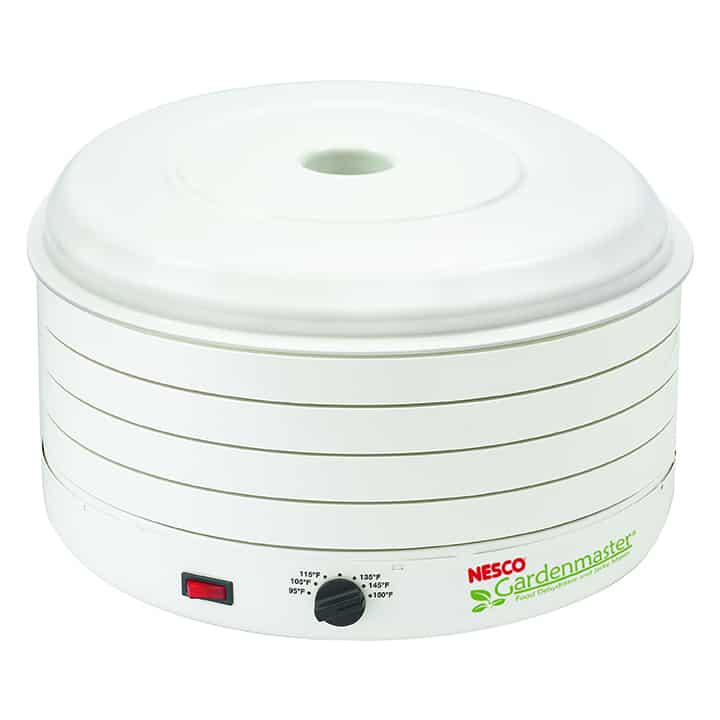
Nesco Gardenmaster FD-1040
Pros
- Expandable to 20 trays
- Digital timer
- Affordable
- Top-mounted fan (no dripping)
Cons
- 160°F max (requires pre-heating)
- Requires tray rotation
- Round trays limit strip length
The Gardenmaster offers the safest budget option for jerky, though it requires extra steps. The 160°F maximum air temperature typically results in 145-150°F internal meat temperature—below the safety threshold. You must pre-heat meat in a 300°F oven for 10 minutes before dehydrating to ensure safety.
Once this protocol is followed, the Gardenmaster produces excellent jerky. The expandable design grows with your needs, and the digital timer prevents over-drying. It’s the best entry-level option for those willing to follow safety protocols. Read full review.
Feature Comparison
| Model | Price | Max Temp | Capacity | Safe for Jerky? |
|---|---|---|---|---|
| Excalibur 9-Tray | $320-380 | 165°F | 6 lbs | Yes |
| Cosori Premium 6 | $160 | 165°F | 4 lbs | Yes |
| LEM MightyBite | ~$190 | 167°F | 5 lbs | Yes |
| Cabela’s Heavy Duty | $140-170 | 160°F | 4 lbs | Yes |
| Nesco Gardenmaster | $90-120 | 160°F* | 3-7 lbs** | With pre-heat |
* 160°F air temperature typically yields 145-150°F internal meat temperature, requiring oven pre-heating.
** Expandable; 3 lbs with base trays, up to 7 lbs fully expanded.
Budget Alternatives
If the top picks exceed your budget, these alternatives work with proper safety protocols:
Presto Dehydro ($60-80): Reaches only 145°F internal temperature, but works if you pre-heat meat in the oven before dehydrating. Fast drying due to high wattage, but requires constant supervision.
Weston 6-Tray ($90-110): Reaches 150-155°F internal temperature. Requires oven pre-heating for safety, but offers digital controls and even drying for the price.
Vevor 10-Tray ($120-160): Stainless steel construction and high wattage, but runs 10-15°F cooler than indicated. Must verify temperature with probe thermometer and adjust settings accordingly.
Whatever dehydrator you choose, invest in a quality instant-read probe thermometer ($15-25). This is non-negotiable for jerky safety. Even high-end dehydrators can have temperature calibration issues. Verify the internal temperature of your meat strips during the first few batches to understand your unit’s specific behavior.
Conclusion
For pure jerky-making performance, the Excalibur 9-Tray remains undefeated with its capacity, reliability, and safety margins. However, the Cosori Premium 6-Tray delivers 90% of that performance at half the price, making it the best choice for most households.
Hunters processing game meat should consider the LEM MightyBite for its 167°F maximum and meat-specific design. Budget buyers can safely use the Nesco Gardenmaster provided they follow oven pre-heating protocols.
Remember that even the best dehydrator requires proper technique. Always slice meat uniformly, verify internal temperatures, and cool jerky completely before storing. For detailed recipes and safety guidelines, see our complete beef jerky guide and temperature/time charts.
